
Sex Offender Checks in Grant County
The Grant County Sheriff’s Office OffenderWatch search is the main local access point for public Washington Sex Offender Public Registry information. It supports searches by a person’s name and by a place. A place search can be more useful when the question concerns a home, school route, park, or other area rather than one known person. The user must first accept the safety and misuse notice. Results may then appear in a list or on a map, subject to the public-notification limits that apply to each classification.
Begin with the narrowest facts you know. Exact spelling helps a name search, while a full address and ZIP help define a location. Read the open profile before drawing a conclusion. A listing reflects a past qualifying conviction and a current registration duty. It does not report a fresh offense, predict conduct, or replace information from the Grant County Sheriff’s Office. For an area that crosses a county or state line, add the federal national search rather than assuming the county map is complete.
Grant County OffenderWatch Address Search
OffenderWatch offers two distinct paths. Name mode is best when the identity is already known. Geographic mode starts with an address, city, Washington selection, ZIP, and a radius offered by the live system. Radius choices can change, so use only the choices shown at the time of the search. Review both the map and list. A pin can mark an approximate area rather than a precise point, and a blank map does not prove that no person with a registration duty is nearby.
Email proximity alerts may be available through the same service. An alert is a way to track published changes near an address, not a substitute for a new search when plans change. Limited public display, a recent move, incarceration, or the timing of an agency update can affect what appears. The sheriff controls local registration and notification work, while Washington law controls which details may be released.
How to Search the Washington Sex Offender Public Registry
The public search is simple, but the result needs care. Grant County delivers its local registry through OffenderWatch, with support from the Washington State Patrol sex and kidnapping offender program. Use the following order to keep the search focused and to avoid treating a broad result list as a verified match.
- Open Grant County OffenderWatch and read the conditions. Accept them only if the search is for lawful safety or awareness purposes.
- Choose name mode when you know a person, or location mode when the question concerns an address. Enter only the fields that fit that mode.
- Review the list and map, then compare names, aliases, photos, descriptors, and published location details before selecting a profile.
- Open the profile and read the risk level, registration status, and qualifying offense in context. Contact the sheriff if a material detail appears wrong.
| Field | Type | Use | Format note |
|---|---|---|---|
| First and last name | Text | Name mode | Surname is the key starting field |
| Address | Text | Geographic mode | Use a complete street address when known |
| City and state | Text or select | Geographic mode | Select a Grant County place and Washington |
| ZIP | Text | Geographic mode | Five-digit ZIP narrows the area |
| Radius | Select | Map range | Available distances vary in the live vendor |
| Email alerts | Signup | Ongoing notice | Tracks published proximity changes when enabled |
Grant County Registry Verification Cycles
The Grant County Sheriff’s Office does more than publish search results. Its Sex Offender Registration and Tracking Unit registers people, checks addresses, and investigates reported noncompliance. The sheriff’s 2023 annual report described a local verification cycle tied to risk: Level 1 addresses every twelve months, Level 2 every six months, and Level 3 every three months. Those intervals describe the county’s verification work in that dated report. They do not set the length of a person’s registration duty.
Verification explains why a profile can change without a new conviction. A move, incarceration, a corrected record, relief from registration, or a classification update can alter the public entry. It also explains why the sheriff is the right office for a factual concern about local compliance. The registry is a public view of the agency’s current releasable information, while the office holds the registration file and performs field checks.
Note: Risk level guides notification and Grant County’s verification cycle; the qualifying offense and Washington law control registration duration.
Inside a Registry Profile
A public Grant County profile can combine identity, registration, and offense fields. Availability depends on the person’s classification and Washington disclosure rules. An alias is a name associated with the registration record, not evidence of another crime. A compliant status means the listed person is currently recorded as meeting registration duties. It is not a guarantee of future conduct. Likewise, risk level is a notification category, not a new sentence.
| Name and aliases | Published identity names used to distinguish a profile and locate related registration entries. |
|---|---|
| Photo and descriptors | A lawfully released current photograph and physical details may help confirm identity. |
| Residence or area | The address or general area made public under the person’s notification rules. |
| Qualifying offense | The historical offense, statute, jurisdiction, and conviction date when released. |
| Risk level | Washington’s assessed community-notification category, usually Level 1, 2, or 3. |
| Registration status | The current recorded compliance or registration state, which can change after verification. |
Vehicle information, scars, marks, tattoos, school data, or other fields may appear only when the live public profile lawfully exposes them. Do not infer missing details. Compare enough released identifiers to avoid a false match, then use the sheriff’s contact channel for a material question about the entry.
Grant County Registry and NSOPW
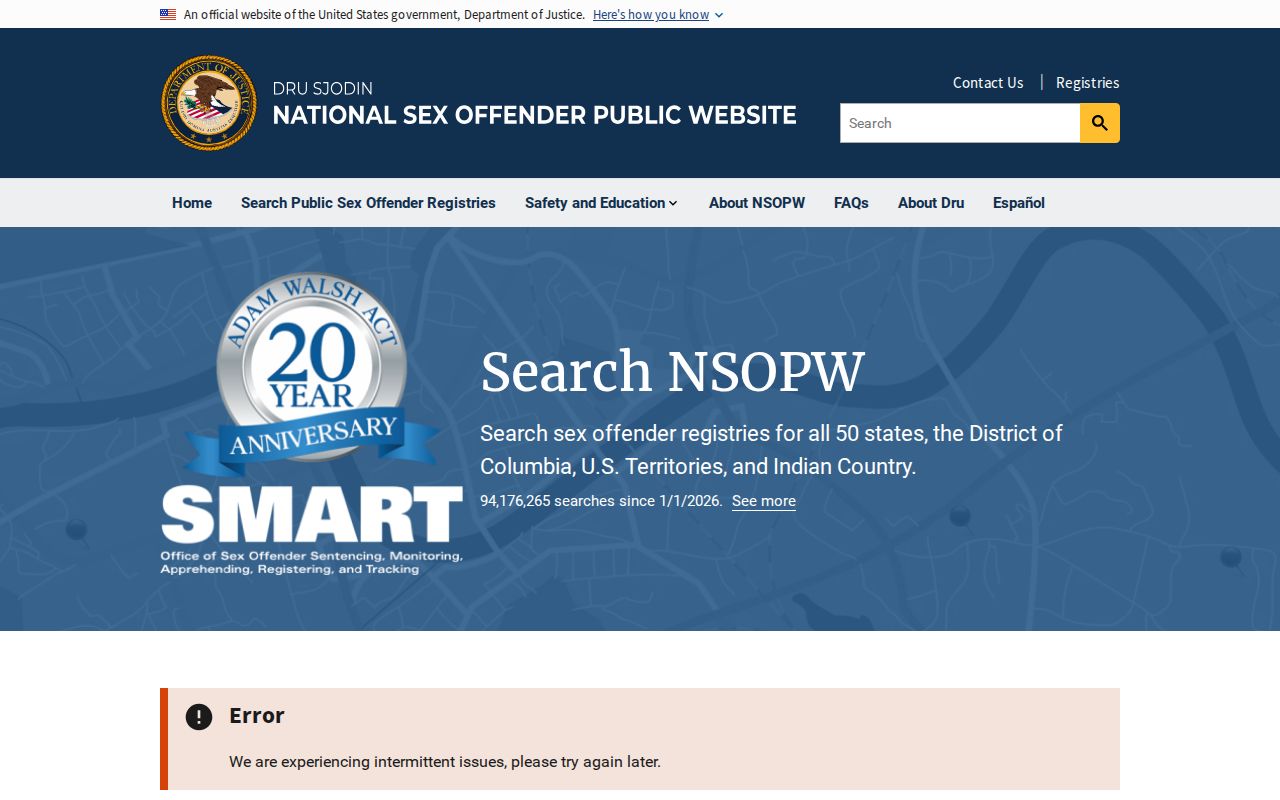
Grant County OffenderWatch is the best local starting point because it connects the search to the sheriff’s own registration work. The National Sex Offender Public Website adds official public records from participating jurisdictions across the country. Use NSOPW when a person recently moved, when a search area reaches beyond Washington, or when a trip or family safety plan crosses county lines. It is a supplement, not a richer copy of the Grant County file.
The national search interface can help readers understand the cross-state layer.
Return to the local sheriff when the result concerns a Grant County address, a local registration question, or possible noncompliance. Local classification and notification details may be clearer there. Neither tool guarantees that every registration record or every field is public.
Washington Registration Levels and Requirements
Washington uses risk levels to set the reach of community notification. Grant County describes Level 1 as the lowest assessed risk with limited public release unless disclosure is legally justified, Level 2 as moderate risk with broader notice, and Level 3 as high risk with broad notice. Registration length is separate. The county FAQ summarizes possible periods of ten years, fifteen years, or life, but the exact duty depends on the offense, conviction history, statute, and any court relief under RCW 9A.44.130.
| Level | Public treatment | Grant verification in 2023 |
|---|---|---|
| Level 1 | Limited dissemination unless legal grounds support release | Every 12 months |
| Level 2 | Broader community notification for moderate assessed risk | Every 6 months |
| Level 3 | Broad community notification for high assessed risk | Every 3 months |
A countywide distance rule should not be assumed. The research found no blanket Grant County residency-distance limit. A person under supervision can have individual court or Washington Department of Corrections conditions, but those terms are not the same as a rule that applies to every registrant.
Grant County Registry Count Changed
A dated count shows why registry totals need context. The Grant County Sheriff’s Office 2023 report listed 247 registered people across its categories: 160 at Level 1, 38 at Level 2, 17 at Level 3, two registered kidnappers, and 30 incarcerated people. The same report recorded nine failure-to-register reports. It also said most registrants were in the Moses Lake area. These figures describe 2023, not a permanent live total.
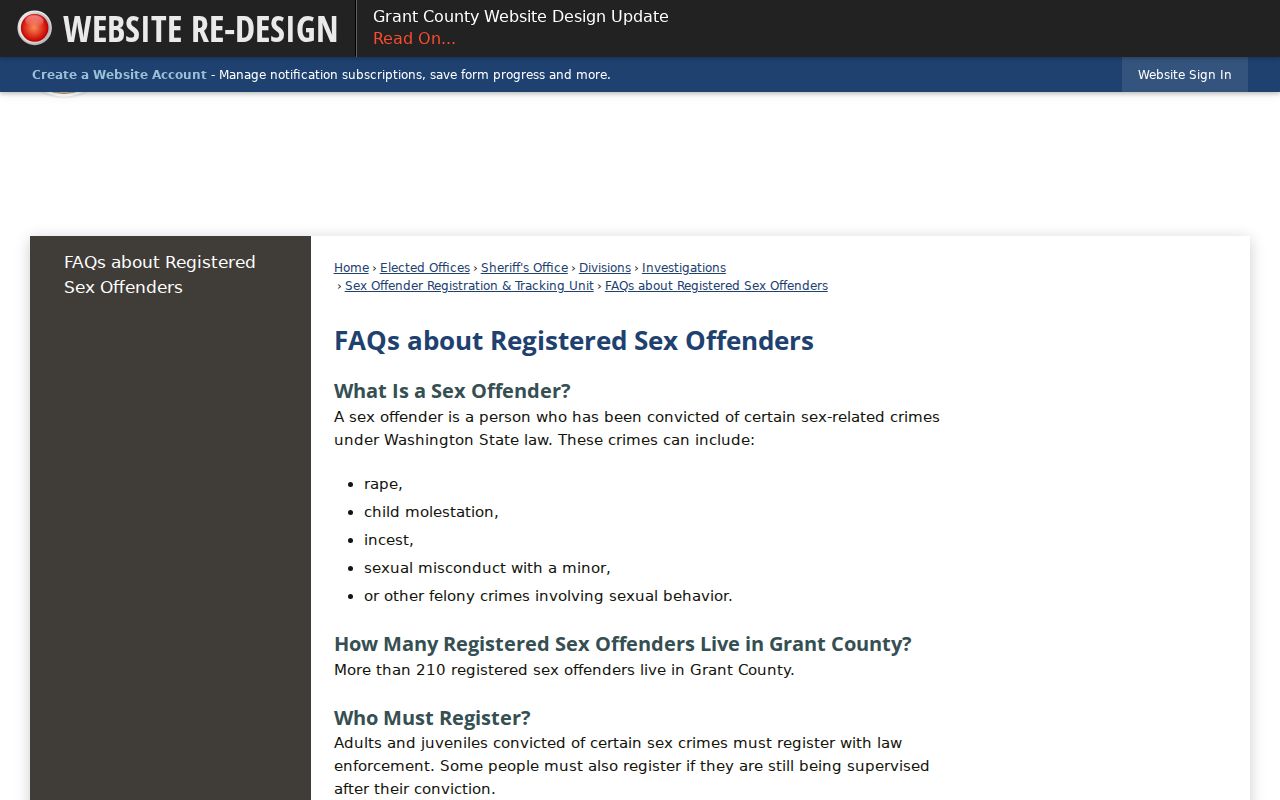
The Grant County registered-offender FAQ now uses the broader description of more than 240 registrants.
Legislative change also moved the count. The sheriff reported that HB 1394 relieved about 68 juvenile registrants on November 1, 2023. Moves, incarceration, death, court relief, new registrations, and data timing can cause more change. A current address question therefore belongs in the live registry, while an annual report is best used to understand the county program.
Report Grant County Registration Concerns
If a public listing appears wrong or a person seems not to meet a registration duty, preserve the profile details and describe the factual concern. Contact the Grant County Sheriff’s Office Sex Offender Registration and Tracking Unit through the sheriff’s main office at 509-754-2018 or case-help extension 2001. Call 911 only for an emergency. Do not visit a listed address, confront a person, or try to perform surveillance.
A map absence can have several causes. Public release may be limited, the person may have moved or become incarcerated, the address may sit outside the chosen radius, or an update may still be processing. Report facts instead of making a public accusation. The unit can compare the public result with the registration file and decide whether a compliance check or correction is needed.
Community Notification and Lawful Use
Washington and Grant County publish registry information for informed safety planning and community awareness. The county notes that listed people have completed the sentence ordered by the court. A registry search result is not proof of a new crime. Use the information to make calm, lawful plans, to sign up for available alerts, or to provide a factual concern to law enforcement. Never use it to threaten, shame, or organize action against a listed person or household.
Use registry data lawfully: Grant County warns that threats, harassment, or intimidation directed at a registrant or household are prohibited and may result in criminal action.
The public record may be limited by classification, law, and current status. Verify a Grant County entry through OffenderWatch and the sheriff before relying on it. For broader geography, compare NSOPW. These official sources support awareness while keeping investigation and enforcement with trained agencies.
Note: A compliant label reports current recorded registration status; it does not certify safety or predict a person’s future conduct.