
Checking Criminal History in Quincy
A Quincy record check works best when the event type is known. Police narratives and evidence stay with the agency that made the report. The Grant County jail answers current or recent custody questions. Court files show what prosecutors filed and how the case moved. WATCH, the Washington State Patrol product, returns the public part of a statewide identity-based history. A missing result in one source does not cancel information held by another.
- Start with Quincy Police Records when the goal is a local incident or arrest report.
- Use the city's public-records process and give a narrow date, location, record type, and case number when known.
- Check the Grant County jail roster for custody, then call the jail if the list does not resolve the question.
- Ask Grant County District Court about limited-jurisdiction cases or search Superior Court through Odyssey for a felony filing.
- Use WATCH for the official public Washington response or WSP subject review for your own fuller state record.
Bring exact spellings, a date of birth when appropriate, and an approximate date range. A recent Quincy arrest may not yet have a court cause number. The incident report, jail entry, and later docket can also show different charges because the prosecutor makes the filing decision.
Three Quincy Police Records Clerks
The Quincy Police Records Division operates just inside the front doors at 223 1st Avenue SW. Three full-time police clerks staff the counter. Published hours are 9 a.m. to 5 p.m. on weekdays, excluding holidays, and the office number is 509-787-4718. This is the local point for help with police records and the department's fingerprint service.
The official records-counter image comes from the Quincy Police Records Division page.
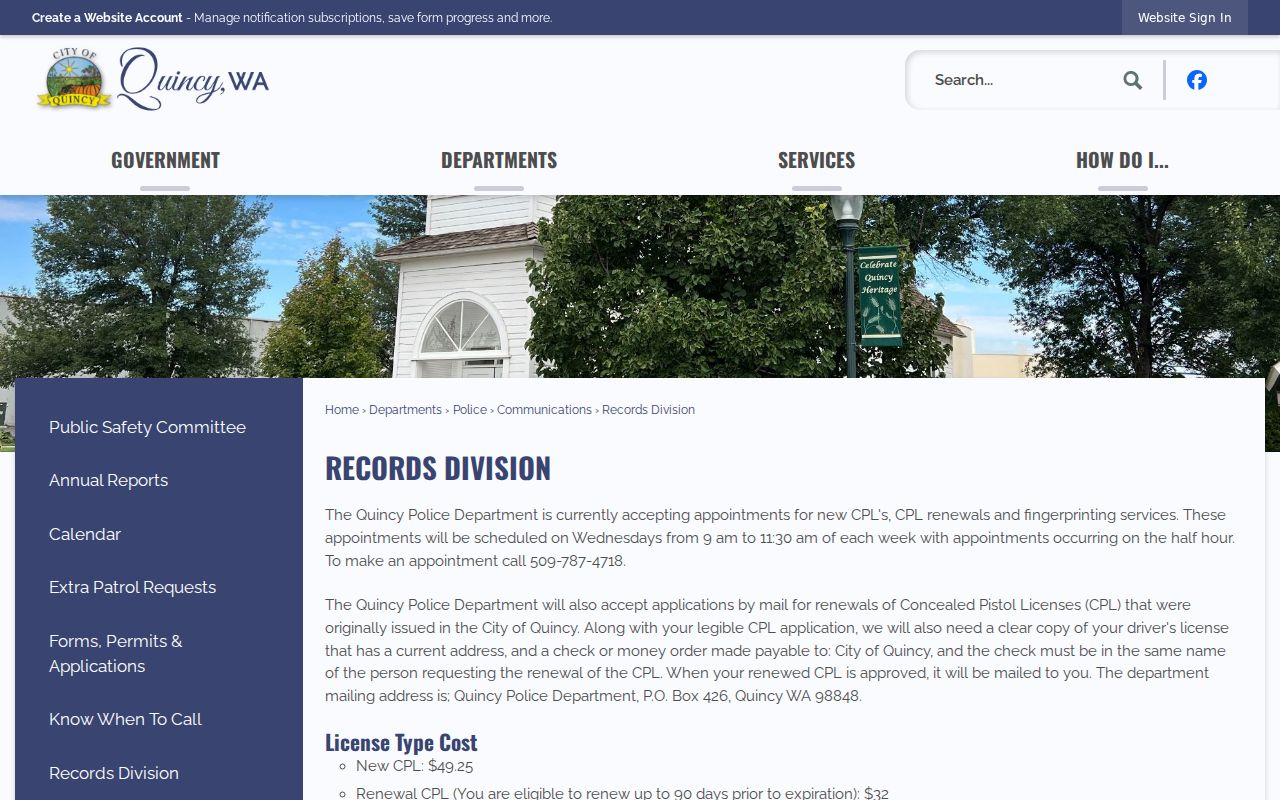
The published counter details make the police station useful for record-specific help, but formal city PRA intake is routed through a different office.
Quincy Police Department Records
Quincy Police creates the narrative and evidence record for its own calls, investigations, and arrests. A responsive file may include a case number, incident date and place, officer actions, alleged offenses, property or evidence references, and referrals. Public disclosure can remove victim, witness, minor, medical, personal-identifier, intelligence, or active-investigation details. Redaction means protected parts are withheld while releasable parts are produced.
Be precise about the sought record. Name the Quincy Police Department, the incident type, the date range, and the location. Add the case number and involved name when known. A request for everything about one person is much harder to identify and may cross several custodians. Emergency-call audio or CAD can belong to MACC rather than Quincy Police, while a court judgment must come from the court.
Quincy has no verified public police arrest log or municipal criminal name-search portal in the official research. The correct fallback is the records counter and city request process, followed by the county jail and courts when custody or prosecution is the real question.
Quincy City Hall Record Requests
Formal Quincy Public Records Act intake goes to City Hall at 104 B Street SW, not the police counter. The mailing address is P.O. Box 338, Quincy, WA 98848. The Public Records Officer can be reached at 509-787-3523 ext. 204. A requester may use the counter, mail, the online route, email, or the dropbox at the northwest corner of City Hall. That range of channels matters when the police counter is closed or the request concerns more than a police record.
The official Quincy public-records page is the source for the city's request routes.
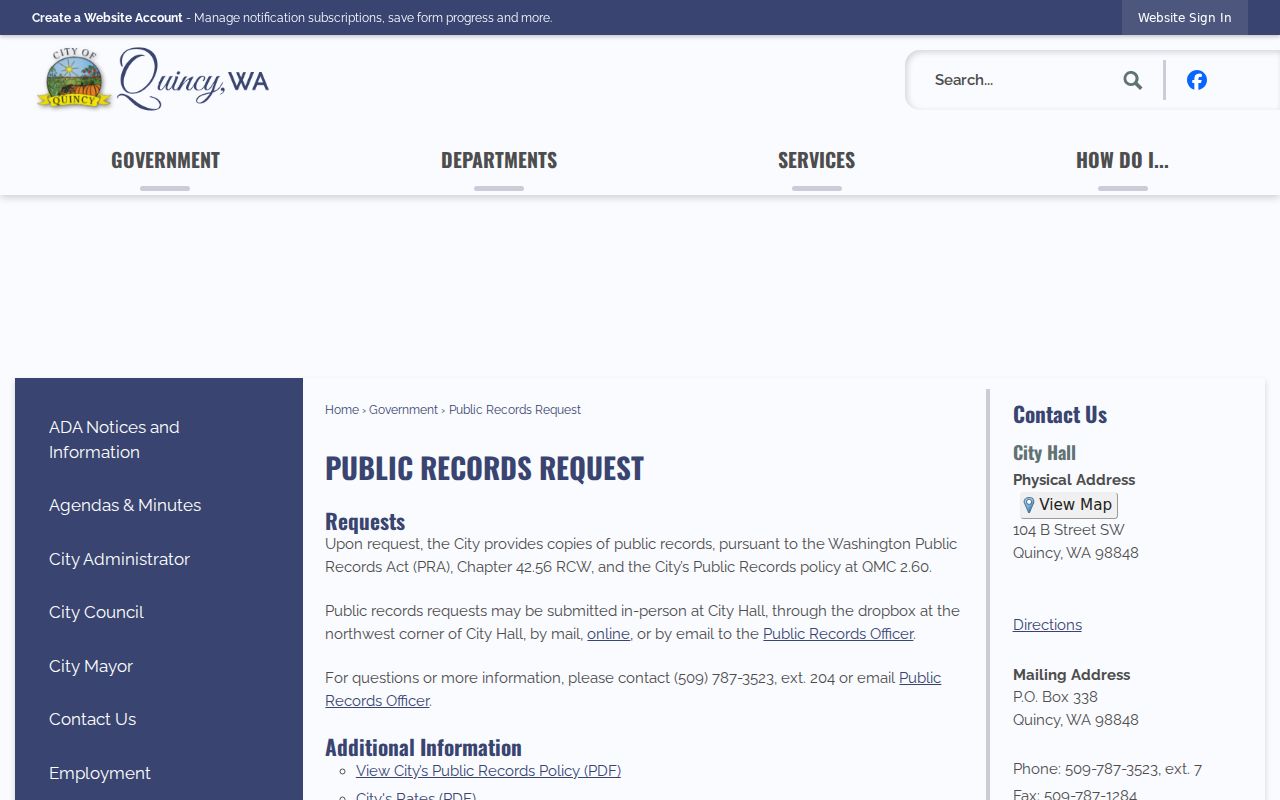
The city request page separates formal PRA handling from the records help available at the police station. The official Quincy homepage also identifies City Hall as the city government hub.
The two addresses are easy to confuse: police records help is at First Avenue SW, while the PRA officer and dropbox are at B Street SW.
Quincy Arrests and Bookings
Quincy Police owns its arrest narrative, but people booked after a city arrest enter the Grant County jail system in Ephrata. The jail creates intake, confinement, fingerprint, and release records. Its public roster is a list or PDF rather than a full profile search. Under RCW 70.48.100, the public core covers name, time and date and cause of confinement, and time and date and manner of discharge. A roster entry proves custody at a stated time, not guilt.
If a person is absent from the roster, they may have been cited and released, released before the list refreshed, transferred, recorded under a name variant, or never booked. Call the jail at 509-754-2011 ext. 2400 or 2401, then return to Quincy Police for the incident report. Filed charges may appear later in District or Superior Court. Booking photographs are not a normal public feature of the Grant roster.
The full county access chain is covered in the Grant County arrest lookup, while Quincy-specific allegations remain with the city police custodian.
Quincy INET Record Custody
Quincy Police participates in the Grant County Interagency Narcotics Enforcement Team with the Grant County Sheriff's Office, Washington State Patrol, and federal partners. That partnership explains why a Quincy investigation may involve more than one badge and more than one file. It does not make every partner the custodian of every record.
For an INET-related request, identify the lead agency, report number, date, place, and record type before filing. Quincy may hold a city officer's report. GCSO may hold a sheriff-created report. WSP has its own disclosure channel, and federal material may follow federal court or agency rules. The jail still keeps booking events, while the prosecutor and court keep the charge and case file.
Note: A multiagency investigation does not create one combined public-records counter for all Quincy criminal records.
Municipal Court Records in Quincy
No separate Quincy municipal criminal name-search system was verified. Quincy criminal and traffic court records route to Grant County District Court or the Superior Court Clerk based on the charge and case stage. District Court handles misdemeanors, gross misdemeanors, traffic, and felony preliminary proceedings. A felony information is filed in Superior Court and maintained by the County Clerk.
| Local court route | Confirm Quincy limited-jurisdiction and city matters with Grant County District Court. |
|---|---|
| Felony route | Grant County Superior Court, with records kept by the Clerk in Ephrata. |
| Case lookup | Direct District Court inquiry for limited jurisdiction; Odyssey for public Superior Court case data. |
| Docket contents | Cause number, charges, status, events, hearings, disposition, judgment, sentence, and possible warrant events. |
| Document copies | Request from the court of record; anonymous Odyssey access does not open filed documents. |
Grant County District Court is at 35 C Street NW in Ephrata and can be reached at 509-754-2016. Search Odyssey Portal for Superior Court case information. Court records follow General Rule 31, so neither the Quincy PRA officer nor police records counter can provide a court judgment.
Quincy Police Fingerprint Records
Quincy Police Records offers fingerprinting for $10. Confirm the current appointment practice and accepted fingerprint card before visiting. The local fee pays for the fingerprint service described by Quincy Police. It should not be confused with the separate cost of a WSP fingerprint-based criminal history check or another agency's processing fee.
Fingerprints are most useful when a person reviews their own state record and needs reliable identity matching. The Washington State Patrol Identification and Criminal History Section maintains WASIS. Its public WATCH name and date-of-birth product is narrower than a full subject review and can miss nonpublic information. If a Quincy event is wrong in WASIS, the contributing agency and WSP may both be involved in correction.
A fingerprint card alone is not a criminal history report. Ask the receiving agency which card format and submission method it accepts before paying for local capture.
Where Quincy Records Go
A Quincy Police report starts with the city. If an arrest leads to booking, the Grant County jail creates the custody file and sends fingerprints and arrest-cycle information toward WSP. The prosecutor decides whether and what to charge. District Court keeps limited-jurisdiction matters and felony preliminary events, while the Superior Court Clerk keeps a filed felony case. Courts report dispositions back to the state repository.
Record flow: Quincy Police Department › Grant County Jail and Courts › Washington State Patrol
For a very recent event, check Quincy Police and the jail first. For a filed outcome, use the correct Grant County court. WATCH can later show the public statewide response, but it does not replace the officer's narrative or certified court papers. An unreported disposition, spelling variation, or processing lag may require comparison across the three levels.
Quincy Record Deposits and Installments
Inspection of public records is generally free. Quincy policy allows production in installments and a deposit of up to 10 percent of the estimated copy cost. A deposit may matter when a request is large, spans many records, or needs substantial review. It is not a flat charge on every request. The city's normal five-business-day framework concerns its initial response, not a promise that all records will be produced by the fifth day.
The current per-page reproduction rate was not established in the accessible official research. Use Quincy's current City Rates resolution rather than borrowing Moses Lake or Ephrata fees. Actual cost can depend on format, media, postage, installments, and redaction work. A clear request can reduce search time: identify the department, record type, case or incident number, date range, and location.
| Quincy request stage | What may happen |
|---|---|
| Within five business days | Produce, deny with authority, seek clarification, or provide a reasonable estimate. |
| Large request | City may produce responsive records in installments. |
| Copy-cost estimate | City may require a deposit up to 10 percent. |
| Inspection | Review is generally free, subject to scheduling and record protection. |
Quincy Record Denial Review
A written denial should identify the legal basis for withholding a Quincy record or part of it. City policy provides a written petition route to the Public Records Officer and City Attorney. The official framework calls for review within two business days. That is a review period, not a promise that an exempt record will be released.
Quincy may also notify a person whose rights could be affected and may seek court protection before disclosure. Notice is procedural; it does not give a named person an automatic veto. Police accident reports have a separate “interested party” certification route under chapter 46.52 RCW. Use that route only when it fits the requested collision record.
Keep the original request, response, exemption citation, and review petition together. Those documents show whether the dispute concerns a city police record, another Quincy department, or a file that should have gone to a county court.
Public Access Rules in Quincy
The Washington Public Records Act governs identifiable Quincy agency records subject to exemptions. The city may redact active-investigation material, protected personal data, and victim, witness, minor, medical, or intelligence details. Court files are different. General Rule 31 governs access to judicial records, so requests for a Quincy criminal docket or judgment must go to Grant County District Court or the Superior Court Clerk.
Key laws:
Washington Public Records Act, chapter 42.56 RCW gives access to identifiable city records while preserving stated exemptions.
Chapter 10.97 RCW controls criminal-history dissemination and gives a person routes to inspect and correct their own state record.
General Rule 31 places court-record access with the judiciary rather than Quincy's PRA process.
Chapter 46.52 RCW supplies the specialized legal framework for qualifying police accident reports.
Lists of individuals obtained under the PRA may not be used for a commercial purpose. For a personal Quincy criminal history review, verify police facts with the city, filed outcomes with the court, and the statewide identity record with WSP.